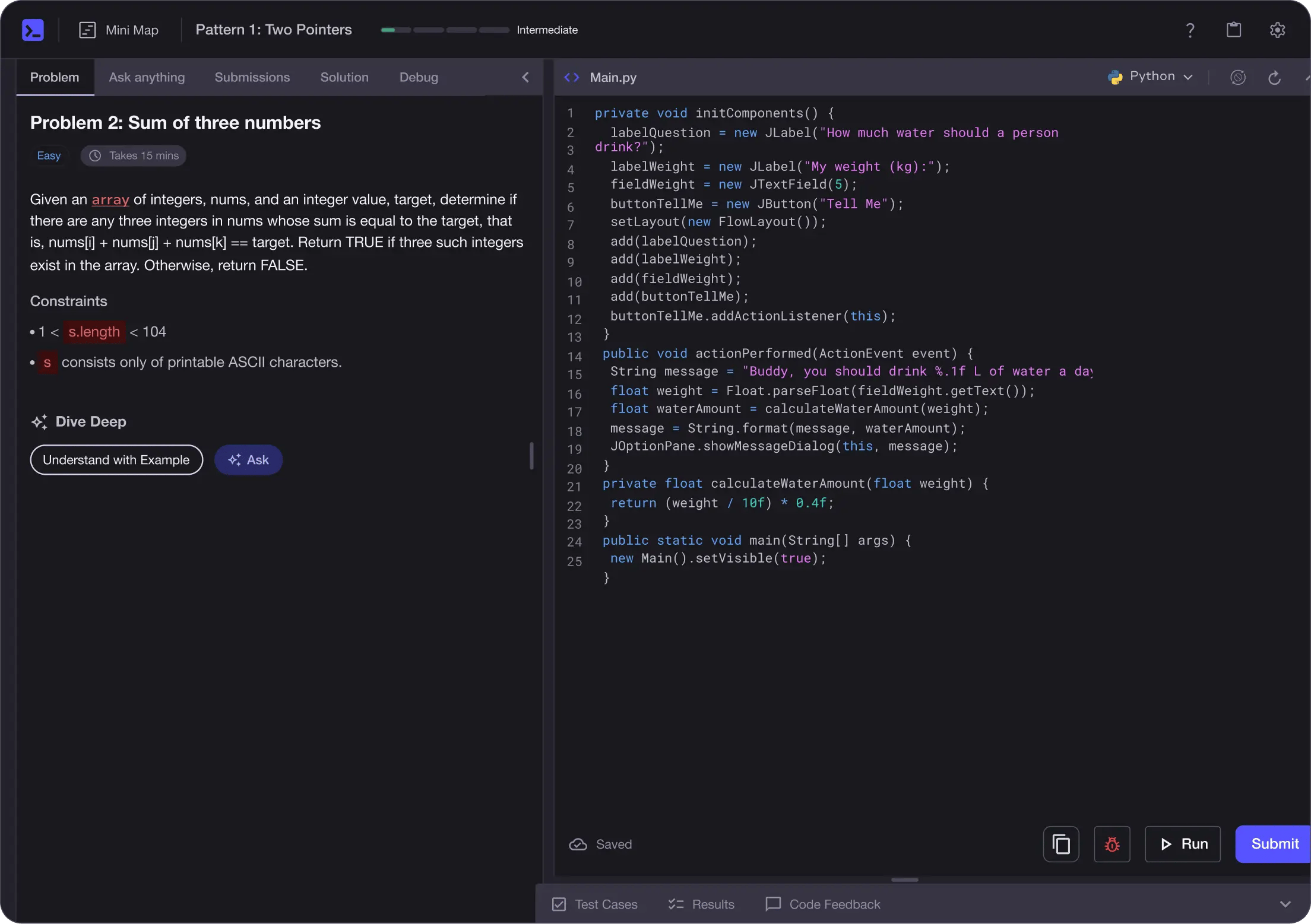
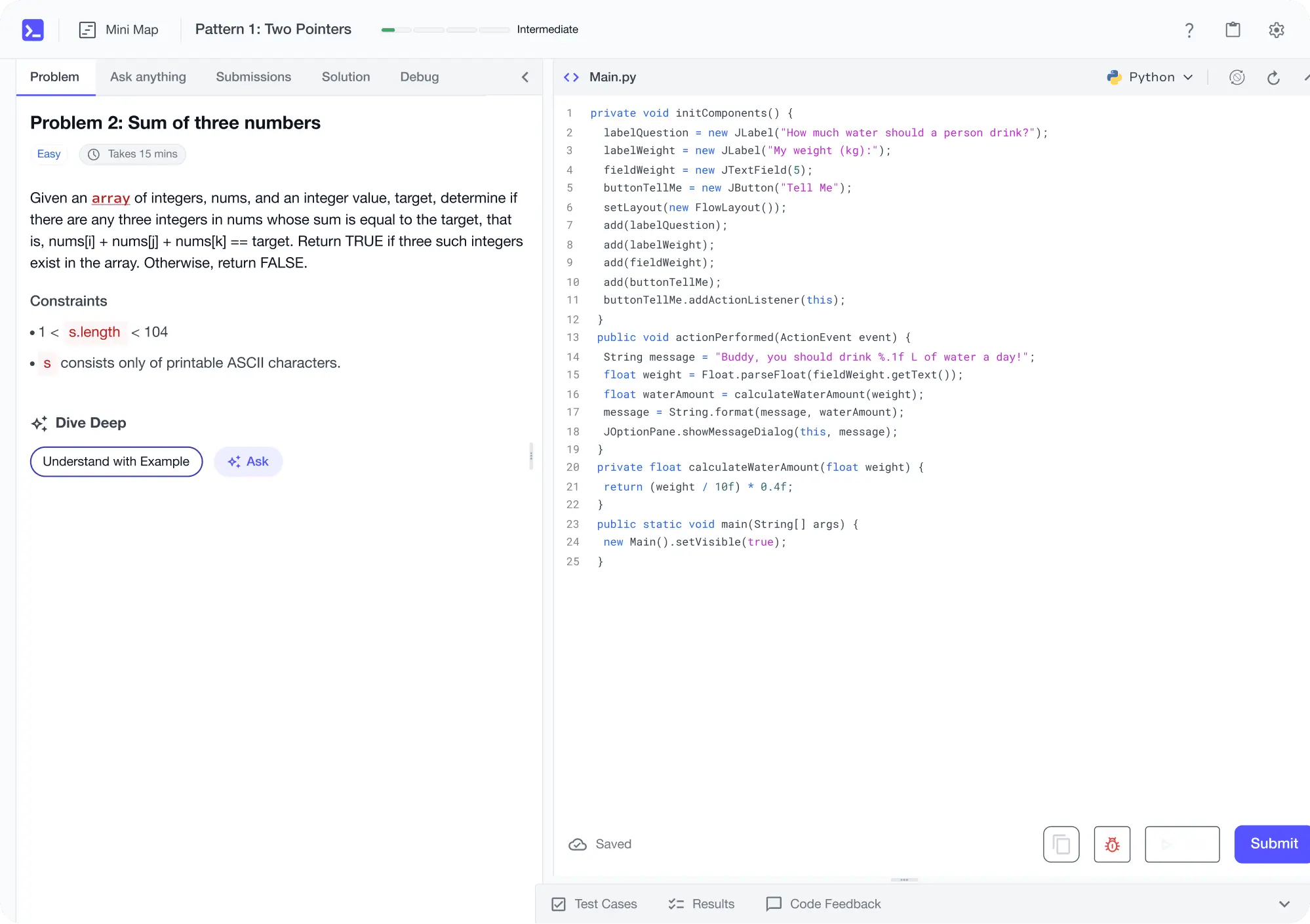
Grokking the Coding Interview Patterns in Python
The ultimate guide to coding interviews, developed by FAANG engineers. Learn patterns to tackle problems from top companies and get interview-ready in just a few hours.

- 1125 lessons across 31 modules
- 579 quizzes with instant feedback
- AI Tutor on every lesson
- Ace Coding InterviewsDemonstrate proficiency in solving coding interview problems using established patterns and techniques, enhancing your job readiness.
- Optimize Problem-Solving SkillsApply efficient data structures and algorithms to improve your coding efficiency and performance in technical interviews.
- Implement Dynamic Programming SolutionsConfidently tackle complex problems using dynamic programming, showcasing your ability to optimize solutions for real-world applications.
- Navigate Graph ChallengesEffectively solve graph-based problems using traversal methods, demonstrating your understanding of connectivity and pathfinding.
- Manipulate Strings with ConfidenceHandle string-related challenges efficiently, showcasing your skills in string manipulation and transformation during interviews.
- Apply Mathematical TechniquesUtilize mathematical reasoning and bitwise operations to solve numeric and geometric problems, enhancing your analytical skills.
Fahim ul Haq is the co-founder and CEO of Educative, a hands-on learning platform for software engineers. He spent nearly a decade as a software engineer at Microsoft and Meta, where he gained deep experience building large-scale distributed systems. His work spanned Project Red Dog at Microsoft, which evolved into Microsoft Azure, and Scuba, Meta's real-time data analytics engine. In 2015, Fahim co-founded Educative to help developers get hands-on with new skills. Fahim's courses have helped hundreds of thousands of engineers learn System Design and prepare for technical interviews. Fahim earned his M.S. in Computer Science from the University of Washington in 2015.
Join 3.1 million developers at
What You'll Learn
- Analyze and apply coding interview patterns to solve common algorithmic problems using Python.
- Implement efficient data structures such as stacks, queues, and hash maps to optimize problem-solving.
- Utilize dynamic programming techniques to tackle complex problems involving optimal substructure and overlapping subproblems.
- Employ graph traversal methods, including depth-first search and breadth-first search, to solve connectivity and pathfinding challenges.
- Master string manipulation techniques to efficiently handle and transform string data in coding interviews.
- Develop skills in mathematical reasoning and bitwise manipulation to solve numeric and geometric problems effectively.
Learning Roadmap
Two Pointers
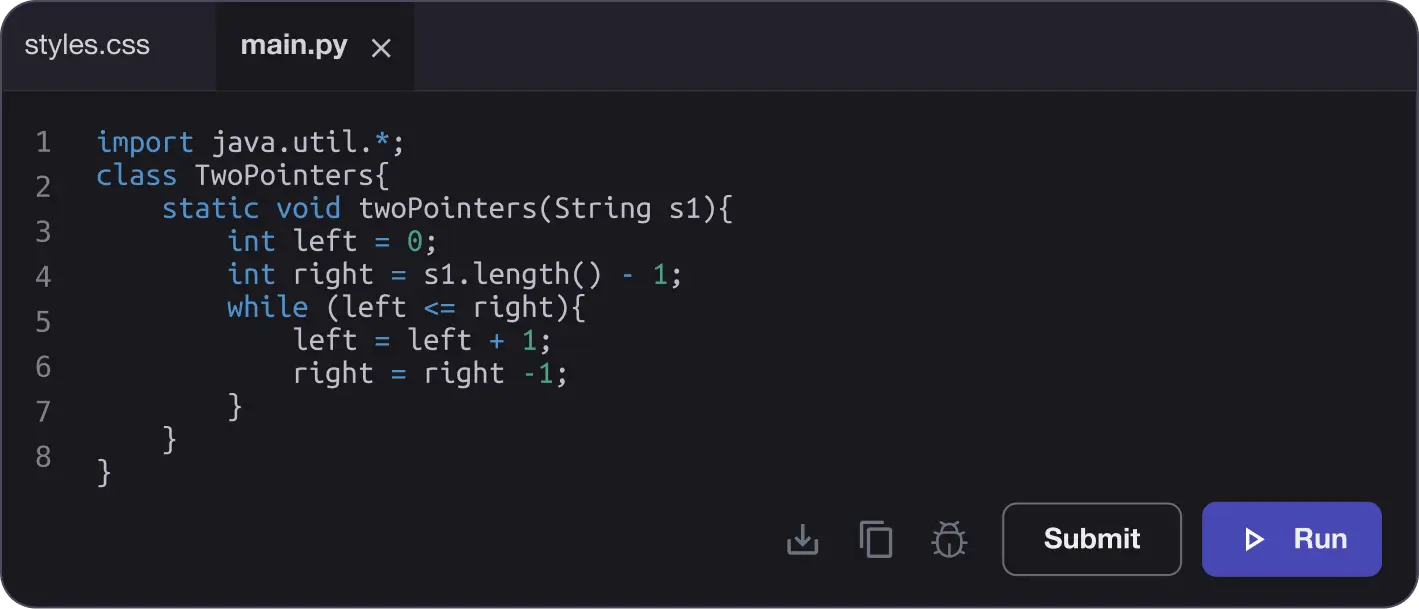
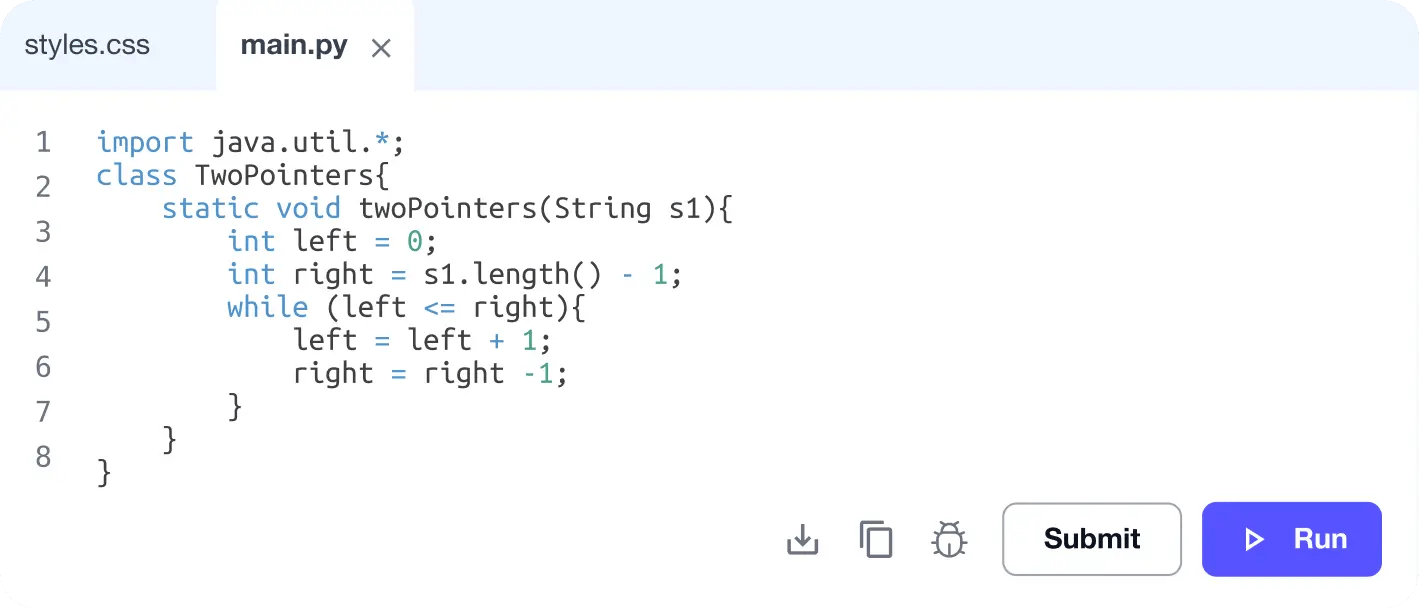
The Two Pointers pattern uses two coordinated pointers or iterators to traverse data efficiently.
Fast and Slow Pointers
Master the steps to use fast and slow pointers for cycle detection and mid-point identification.
Sliding Window
Uses a window, either fixed or dynamic, to optimize the analysis of sequential data (substring or subarray) through iterative processing, minimizing the need for nested loops.
Intervals
Solve problems in merging intervals, inserting and finding intersections of intervals, scheduler tasks, and determining employee free time.
In-Place Manipulation of a Linked List
Two Heaps
A heap is a specific data structure with a fixed ordering (min or max), while a priority queue is an abstract data type that handles custom priority requirements for elements.
K-way Merge
Learn how to use k-way merge for efficient data merging and finding k-th small elements.
Top K Elements
Modified Binary Search
It applies a binary search technique with variations to efficiently solve problems like finding specific targets, peaks (first/last occurrence), or rotated array elements by reducing the search space.
Subsets
Grasp the fundamentals of generating subsets, permutations, and combinations.
Greedy Techniques
Makes locally optimal choices at each step, aiming for a globally optimal solution in problem-solving scenarios, often without reassessment.
Backtracking
Dynamic Programming
Solves complex problems by breaking them into smaller overlapping subproblems and storing results to avoid redundant computations, optimizing time and space.
Cyclic Sort
Step through cyclic sort concepts to efficiently handle various missing and corrupt number scenarios.
Topological Sort
Determines a valid linear ordering of nodes in a directed acyclic graph that has dependencies on each other, crucial in tasks like scheduling or dependency resolution.
Sort and Search
Combines sorting and searching techniques to effectively process and retrieve data, often using sorting algorithms and binary search to optimize problem-solving in datasets that can be ordered.
Matrices
Stacks
Operates on a last-in, first-out principle, where elements are added and removed from the same end, facilitating ordered data processing and retrieval.
Graphs
TBA
Tree Depth-First Search
Traverses a tree by exploring as deeply as possible along each branch before backtracking, which is useful for tasks like traversal, pathfinding, or search operations.
Tree Breadth-First Search
Explores nodes of a tree level by level, ensuring each level is processed before moving to the next, often using a queue to manage traversal.
Trie
Hash Maps
Utilizes a data structure that maps keys to values, enabling efficient insertion, deletion, and retrieval operations for associative arrays.
Knowing What to Track
The Knowing What to Track pattern focuses on identifying and maintaining only the key variables or states necessary to solve a problem efficiently.
Union Find
Maintains disjoint sets, supporting operations to determine the set to which an element belongs (find) and merge two sets (union).
Custom Data Structures
Bitwise Manipulation
It uses binary operations to efficiently perform calculations, comparisons, or transformations directly on bits, optimizing for low-level data control.
Math and Geometry
Applies mathematical concepts and geometric properties to solve problems efficiently, often involving calculations, number properties, coordinate geometry, or transformations.
Challenge Yourself
Test your understanding of various coding challenges focusing on algorithm efficiency.
Course Author:
Fahim ul Haq
Software Engineer, Distributed Storage at Meta and Microsoft, Educative (Co-founder & CEO)
Trusted by 3.1 million developers working at companies
Hitham basheir
Learner
Mina b.
Kona Software Lab Ltd
Ashraf
Learner
Sumit S
Learner
Built for 10x Developers